类的设计和对象创建
类的设计
使用关键字class描述一个类
类是有若干个相同的特征和功能对象的集合,类里面书写对象共有的特征和行为。有属性和函数组成。
默认创建的class是私有权限,也就是private
访问权限:
private:私有权限,当前类里面才能访问
protected: 保护权限,类外不能访问,当前类和子类访问
public: 公开权限,任意地方访问
class Person {public:  string name;  int age;  double score;  int gender;
  void eat() {    cout << "吃饭" << endl;  }
  void sleep() {    cout << "睡觉" << endl;  }};
类的创建
两种方式
// 在栈里面开辟Person person1 = Person();// 在堆上开辟Person* person = new Person();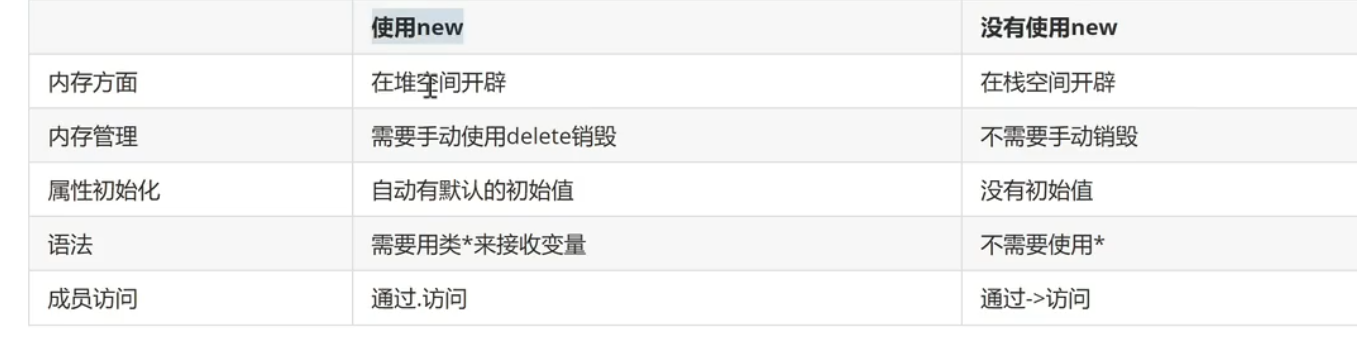
对象大小受非静态数据成员、对齐填充、基类子对象和实现细节影响,不是简单相加。静态成员不计入每个对象的大小。
普通完整空类对象的大小至少为 1,常见实现为 1;继承中的空基类优化等情况另有规则。
成员访问
没有使用new
cout << person1.age << endl;cout << person1.name << endl;cout << person1.gender << endl;cout << person1.score << endl;person1.eat();person1.sleep();使用new
person->age = 90;person->name = "test2";person->gender = 2;person->score = 100;cout << person->age << endl;cout << person->name << endl;cout << person->gender << endl;cout << person->score << endl;person->eat();person->sleep();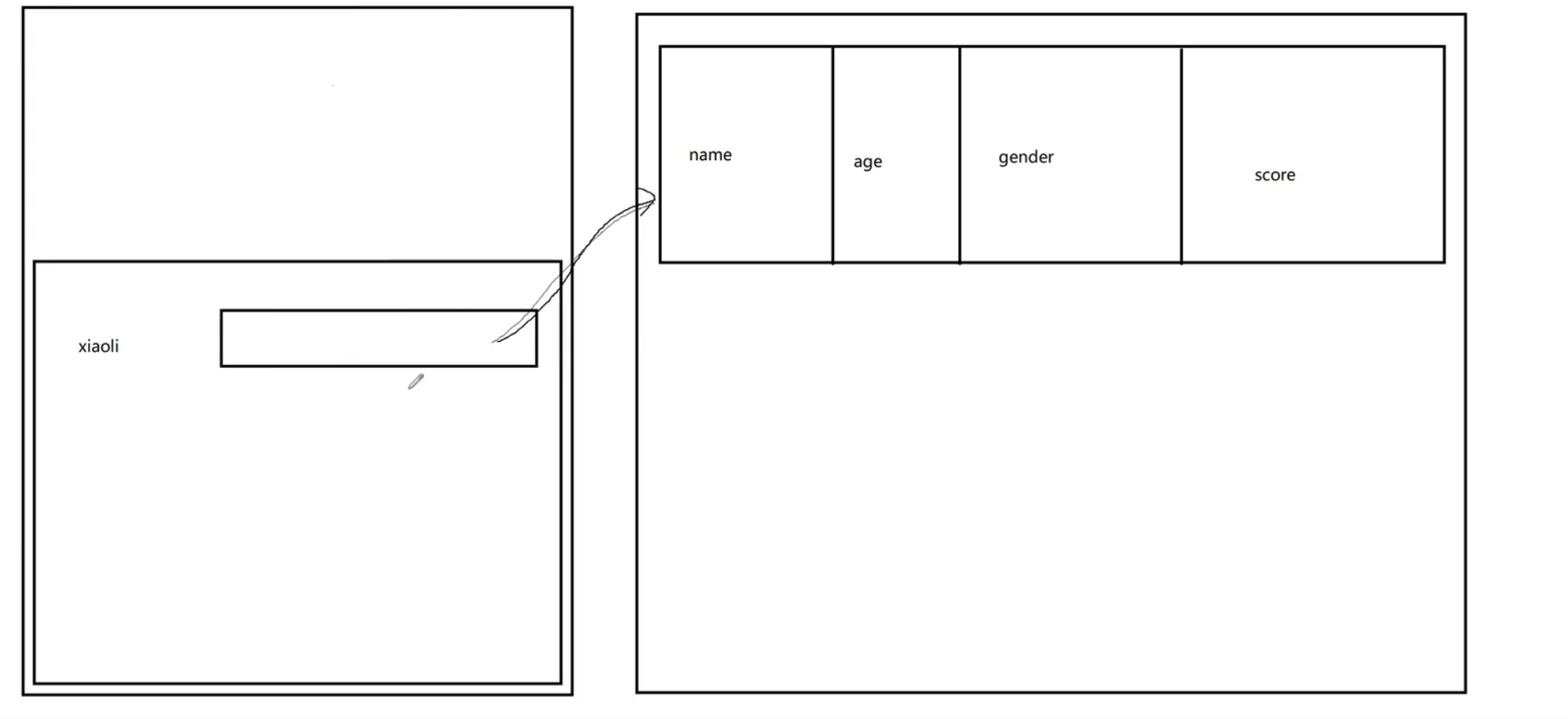
因为是一个指针,所有我们也可以通过指针的方式来访问,比如(*person).age
引入另一个类
class Dog {public:  string name;  int age;};
class Person{public:  string name;  int age;  Dog dog1;
  Dog* dog2;};
两个引用Dog的区别在于
Dog dog1 = Dog()
Dog* dog2 = NULL
所以我们进行访问对应的属性的时候,如果这个属性类是使用指针来创建的话,因为这个指针一开始是空的,所以直接解引用空指针是未定义行为,可能崩溃,也可能出现其他结果,C++ 不会保证抛出 Java 式空指针异常。
  Person p1 = Person();  p1.age = 100;  p1.name = "test";  p1.dog1.age = 2;  p1.dog1.name = "test dog";  cout << p1.age << endl;  cout << p1.name << endl;  cout << p1.dog1.age << endl;  cout << p1.dog1.name << endl;

  p1.dog2 = new Dog();
案例一:老师-学生
xx老师让xx学生上台自我介绍
老师类:
- 属性:姓名
- 功能:让学生自我介绍
学生类:
- 属性 姓名,年龄,性别,成绩
- 功能:自我介绍
#include <string>
#include<iostream>using namespace std;

class Student {public:  string name;  int age;  int sex;  double score;
  void show() {    cout << name<<": 开始自我介绍" <<" 年龄:"<<age<<"  性别:"<<sex<<" 分数:"<<score << endl;  }};
class Teacher {public:  string name;
  void call(Student stu) {    cout << "让学生:"<<stu.name<<"自我介绍" << endl;    stu.show();  }};
int main() {  // 学生初始化  Student stu1 = Student();  stu1.name = "张三";  stu1.age = 18;  stu1.sex = 1;  stu1.score = 80;
  // 老师初始化  Teacher te = Teacher();  te.name = "李四";
  // 核心业务  te.call(stu1);
}
案例二:判断圆是否包含一个点
圆:
- 属性:圆心,半径
- 功能:判断圆是否包含一个点
点:
- 属性:x,y
#include<iostream>using namespace std;
class Point {public:  double x;  double y;};

class Circle {public:  double r;  Point center;
  bool contains(Point point) {    // 计算两点距离的平方    double dis = (center.x - point.x) * (center.x - point.x) + (center.y - point.y) * (center.y - point.y);    // 计算平方和和半径的关系    return dis >= r * r;  }};
int main() {  // 点  Point point = Point();  point.x = 2;  point.y = 4;
  // 圆  Circle circle = Circle();  circle.r=1;  circle.center.x = 2;  circle.center.y = 4;
  cout << (circle.contains(point) == 1 ? "true" : "false") << endl;;}
类外和其他文件实现类函数
将函数移到外面创建
class Person {public:  void sleep();};
void Person::sleep(){  cout << "sleep" << endl;}
可以在新建里面选择对应的类,会创建对应的头文件和cpp文件实现
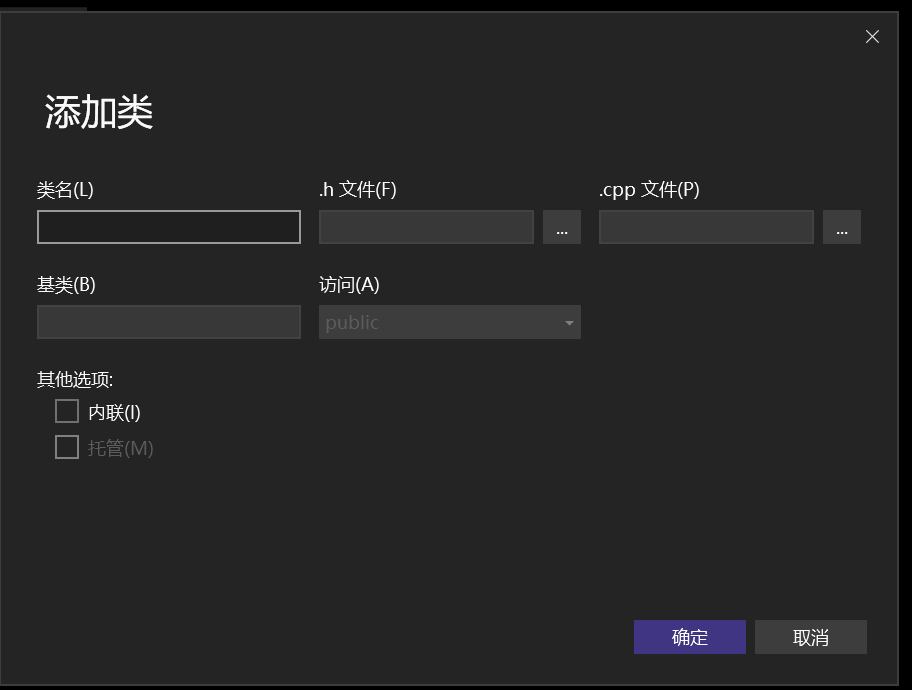
静态
使用关键字static
静态常量
const static int
静态函数
static void show
静态属性
静态数据成员具有静态存储期,由类的所有对象共享。初始化可能是常量初始化,也可能包含程序启动后的动态初始化,不能统一说编译时已经完成。
静态属性的空间开辟早于对象的创建,静态属性不属于对象,被所有的对象共享。
访问方式
- 通过对象访问
- 通过类访问(推荐)
#include<iostream>using namespace std;
class MyNumber {public:  // 静态成员  static int a;  // 静态常量,数据类型是整型,允许在定义的时候进行初始化赋值,其他类型不允许  const static int PI = 3;
  const static double PI2;
  // 静态函数  static void show() {    cout << "静态函数的调用" << endl;  }};
int MyNumber::a = 10;const double MyNumber::PI2 = 3.1;

int main() {  // 对象进行访问  MyNumber num1;  MyNumber num2;
  cout << num1.a << endl;  cout << num2.a << endl;
  // 修改了一个值会修改所有的值  num1.a = 100;  cout << num1.a << endl;  cout << num2.a << endl;


  // 类访问  MyNumber::a = 200;  cout << num1.a << endl;  cout << num2.a << endl;

  // 调用函数  MyNumber::show();}
构造函数
构造函数分类
- 参数:有参和无参构造
- 类型:普通构造,拷贝构造
构造函数的定义
对对象属性初始化的赋值操作
class Per {public:  Per() {    cout << "无参构造" << endl;  }
  Per(int age) {    cout << "有参构造" << endl;  }
};
构造函数的调用
  // 1.显示调用  Per per1 = Per();               // Per per1; 缩写不能加上()  Per per2 = Per(10);        // Per per2(10)  Per per3 = Per(10, 10);      // Per per3(10,10)
  //2. 隐式调用  Per per4 = {};  Per per5 = { 10 };  Per per6 = { 10,10 };
explict关键字
放在构造函数前面修饰构造函数,无法使用隐式调用
explicit Per(int age) { cout << "{int}有参构造" << endl; }注意事项
如果我们创建了一个空的对象。系统会默认帮我们创建一个空的构造函数。但是如果我们重写了新的构造函数,那么原本的空参就不会存在了,此时如果还是空参调用,就会报错。
所以一般情况下,我们会主动再写一个空参构造。
构造函数初始化
#include <string>
#include<iostream>using namespace std;

class Pers {public:  string name;  int age;  string sex;  int score;
  Pers() {    name = "";    age = 0;    sex = "";    score = 0;  }
  //Pers(string n,int a,string g,int s) {  //  name = n;  //  age = a;  //  sex = g;  //  score = s;  //}
  Pers(string n, int a, string g, int s) :name(n), age(a), sex(g), score(s) {  }
  void show() {    cout << "name=" << name << " age=" << age << " sex=" << sex << " score=" << score << endl;  }};
int main() {  Pers per = Pers("test",12,"nan",88);  per.show();  return 0;}
拷贝构造函数
根据一个对象拷贝出另一个对象,这两个对象的值相等,但是地址不相同
可以看作一个常量引用,如果不创建,就会使用默认的拷贝构造函数
Pers(const Pers& per) { cout << "拷贝构造函数调用了" << endl; name = per.name; age = per.age; sex = per.sex; score = per.score; }Pers per = Pers("test",12,"nan",88);Pers per2 = per;析构函数
对象生命周期的终点,对象被销毁之前调用
资源释放,堆内存释放
使用~
#include<iostream>using namespace std;
class Perso {public:  int a;  ~Perso() {    cout << "析构函数被调用了" << endl;  }};

void test() {  Perso person;  // 栈里面,test调用结束后才会释放}

int main() {  test();
  //Perso* person = new Perso();    // 释放堆空间  //delete person;
  system("pause");  return 0;}
因为函数里面的对象是在栈里面,调用方法结束后会自动化销毁
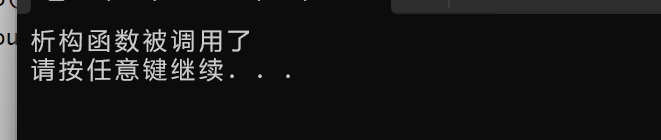
如果使用的是指针创建, Perso* person = new Perso();对象通常位于动态分配的存储中,仅让局部指针离开作用域不会销毁该对象;delete 或拥有它的智能指针会触发析构。
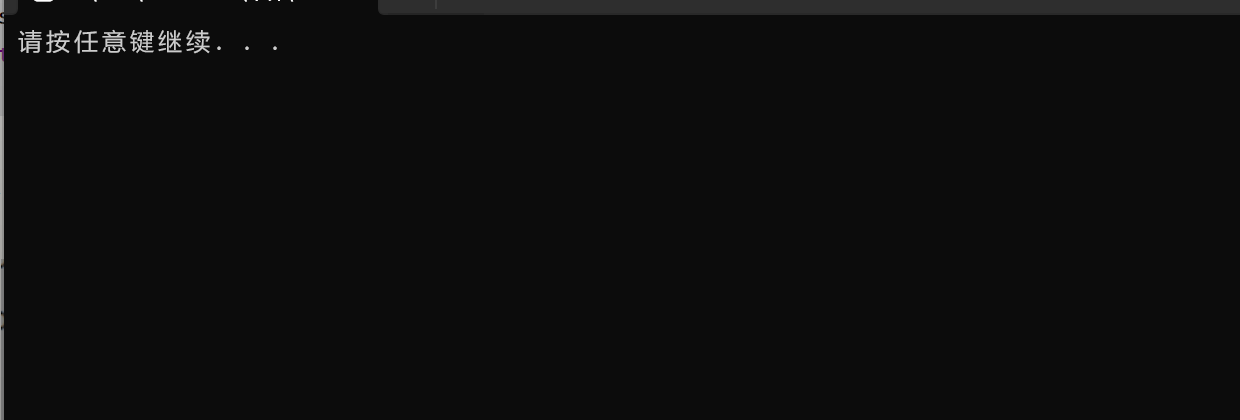
所以必须要使用delete来删除占用
浅拷贝和深拷贝
浅拷贝:在拷贝函数中,直接完成属性的值拷贝
深拷贝:在拷贝函数中,创建新的空间,属性中的指针指向一个新的空间
浅拷贝
#include <string>
#include<iostream>using namespace std;

class Cat {public:  string name;  int age;};

class Person {public :  int age;  Cat* pet;
  Person() {    age = 0;    pet = new Cat();  }
  // 拷贝构造函数  Person(const Person& p) {    age = p.age;    // 默认是浅拷贝    pet = p.pet;    // 深拷贝    //pet = new Cat();    //pet->name = p.pet->name;    //pet->age = p.pet->age;  }
  // 析构函数  ~Person()  {    cout << "开始调用析构函数" << endl;    if (pet != nullptr) {      delete pet;      pet = nullptr;    }
  }};
int main() {  Person test1;
  Person test2 = test1;
  system("pause");  return 0;}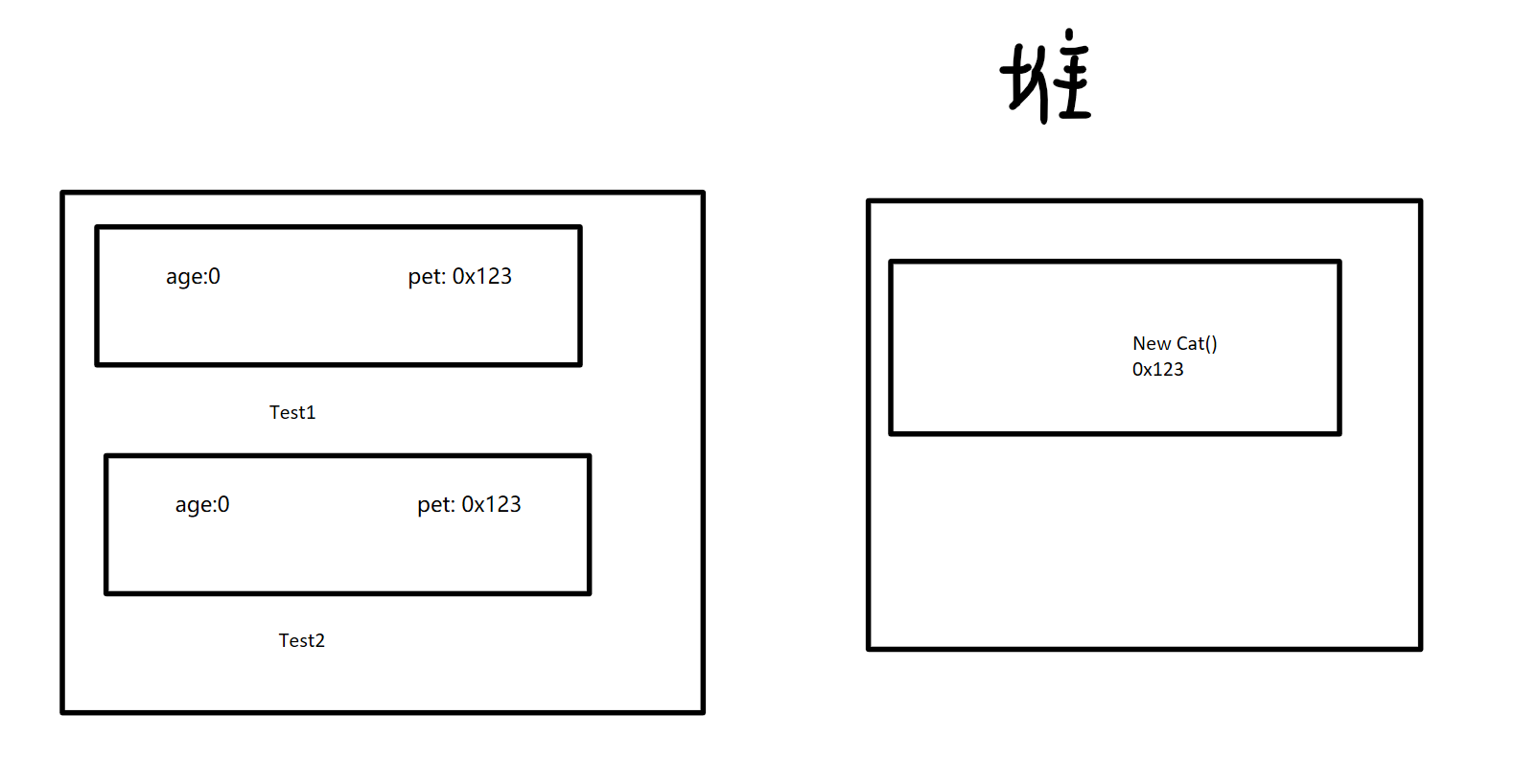
上图我们可以看到两个对象都是使用的同一个cat空间,但是一旦test2执行完成了,会执行析构函数,变成下图
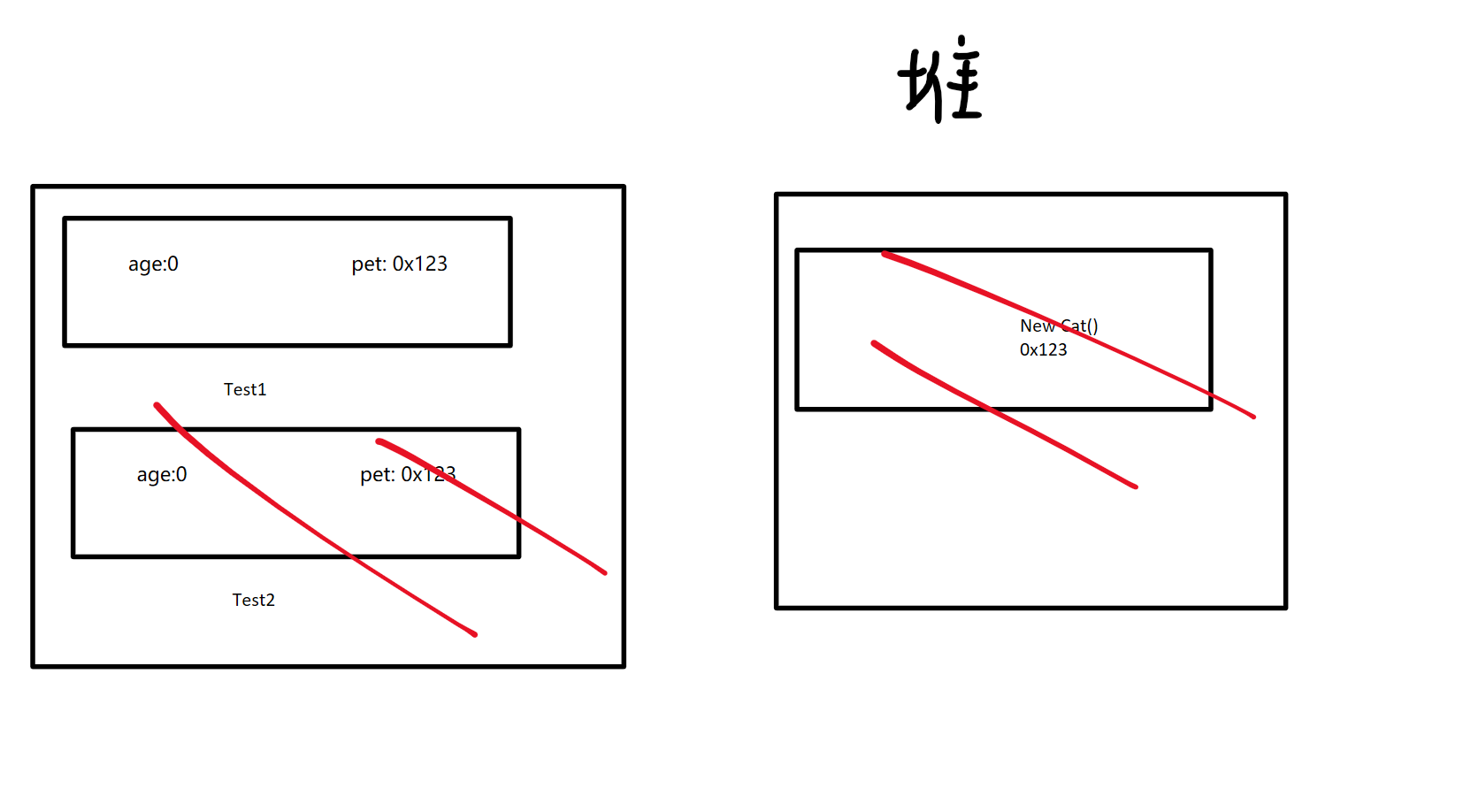
所以会导致第一个对象里面遗留了一个野指针。
深拷贝
pet = new Cat();pet->name = p.pet->name;pet->age = p.pet->age;这样就会创建两个pet在堆里面,析构函数执行的时候就不会出现野指针的情况
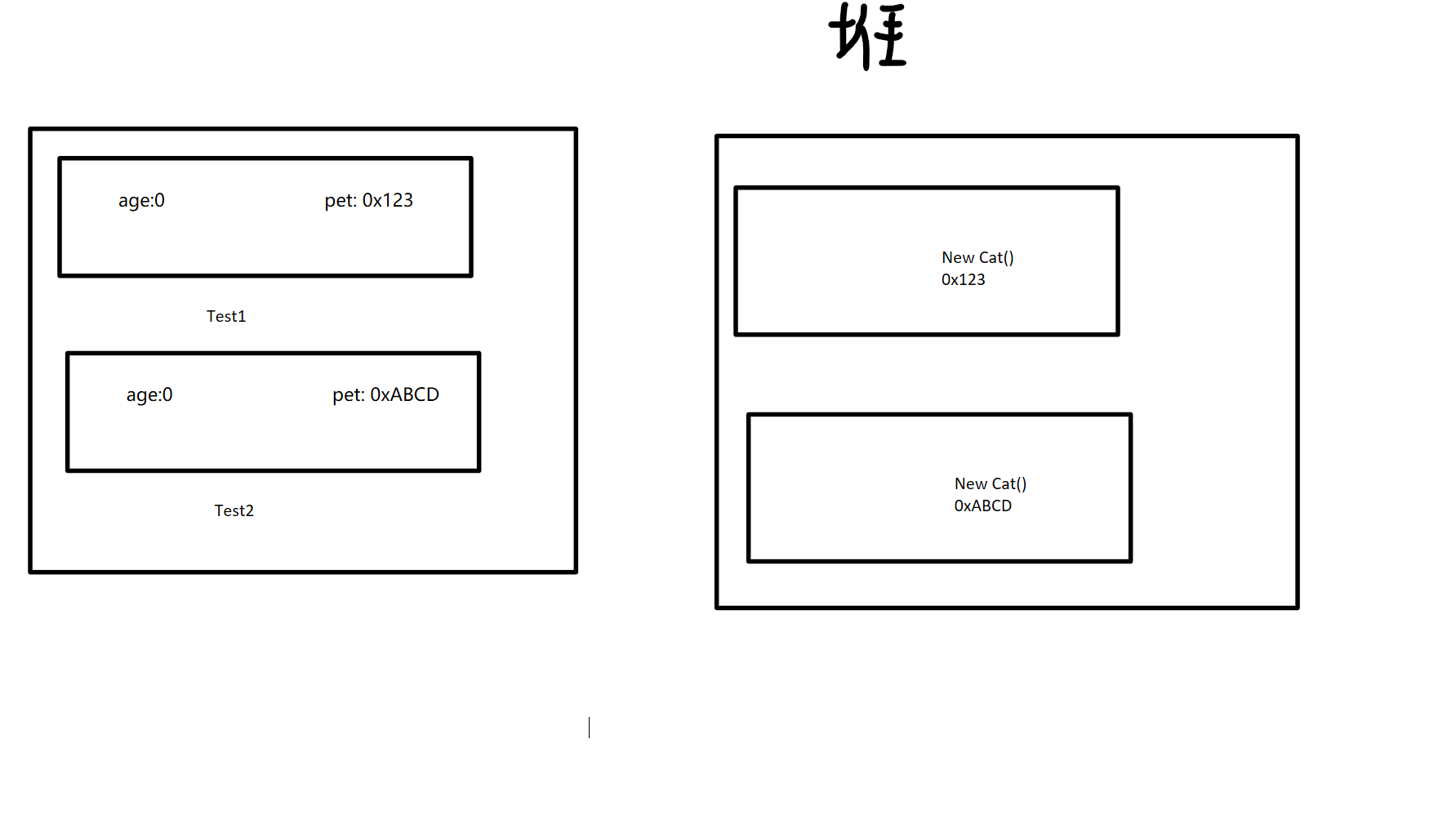
this指针
使用
指向当前对象的指针,谁调用这个函数,这个this就指向谁
#include<iostream>using namespace std;
class Person {public:  int age;  Person() {    age = 0;  }  Person(int age) {    age = age;  }  //Person(int age):age(age){}};
int main() {  Person xiaoming(10);  cout << xiaoming.age << endl;
  Person xiaobai(20);  cout << xiaobai.age << endl;
  return 0;}
以上代码运行的时候会存在问题,一个是代码提示,另一个是执行结果的原因
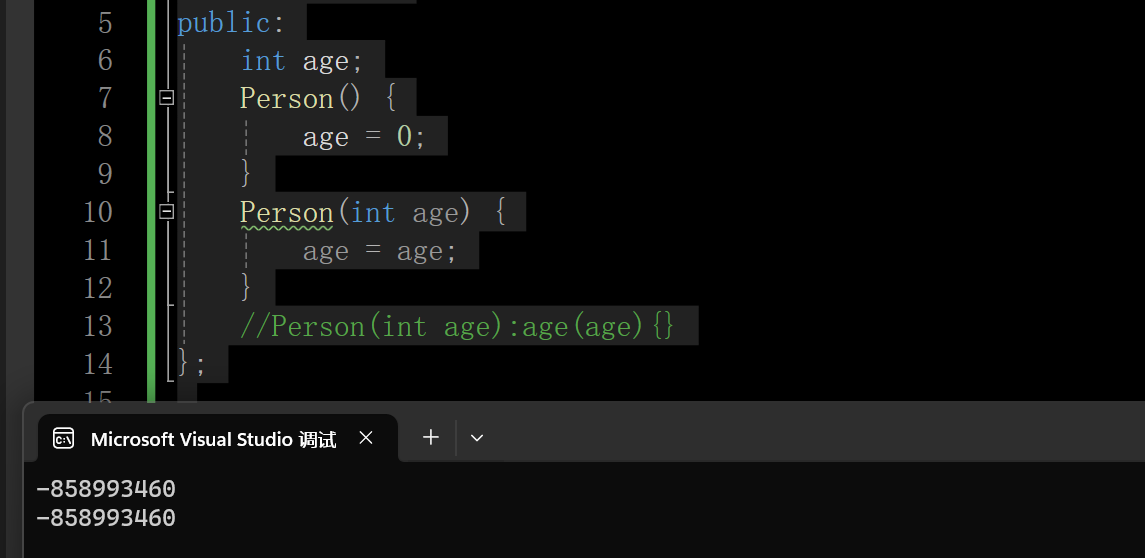
因为这两个变量名重复了,所以无法分辨是哪个变量的赋值,三种解决方案
- 参数名或者变量名不一样,要有区分
- 使用this指针
this->age = age; - 构造函数初始化,Person(int age):age(age){}
this不能省略情况
- 局部变量和属性名字相同的时候,需要使用显示的this,一般情况下this可以省略
返回当前对象的函数
在函数上面可以使用引用,这样就能避免在内存上创建两个当前的资源,然后返回的时候可以使用*this指针指向当前对象
#include<iostream>using namespace std;
class MyNumber {private:  int n;
public:  MyNumber() :n(0) {};  MyNumber(int n) :n(n) {};

  // 返回当前的对象,可以使用引用,避免值拷贝  MyNumber& add(int n) {    this->n += n;    return *this;  }

  MyNumber& mins(int n) {    this->n -= n;    return *this;  }};


int main() {  MyNumber myNumber = { 10 };  MyNumber res = myNumber.add(10).add(20).mins(10);}
而且这样还能使用流式或链式调用。
空指针
通过空指针调用非静态成员函数是未定义行为。即使函数暂时不读成员,或内部检查 this == nullptr,也不能保证安全;应在调用前检查指针。
#include <iostream>struct MyNumber { int age = 10; void show() const { std::cout << age << '\n'; }};int main() { MyNumber* number = nullptr; if (number) number->show(); else std::cout << "没有对象,跳过调用\n";}常函数
- 使用const修饰
- const 成员函数不能通过普通的 this 访问修改非 mutable 成员。
- const 成员函数不能通过当前 const 对象调用非 const 成员函数,但可以调用普通自由函数、静态函数以及其他对象允许调用的方法。
#include <string>
#include<iostream>using namespace std;
class Person {public:  string name;  int age;  Person() :name(""), age(0) {};  Person(string name, int age) :name(name), age(age) {};
  void changePerson(string name, int age) {    this->name = name;    this->age = age;  }};

int main() {
}
给changePerson加上const,发现无法赋值,报错。
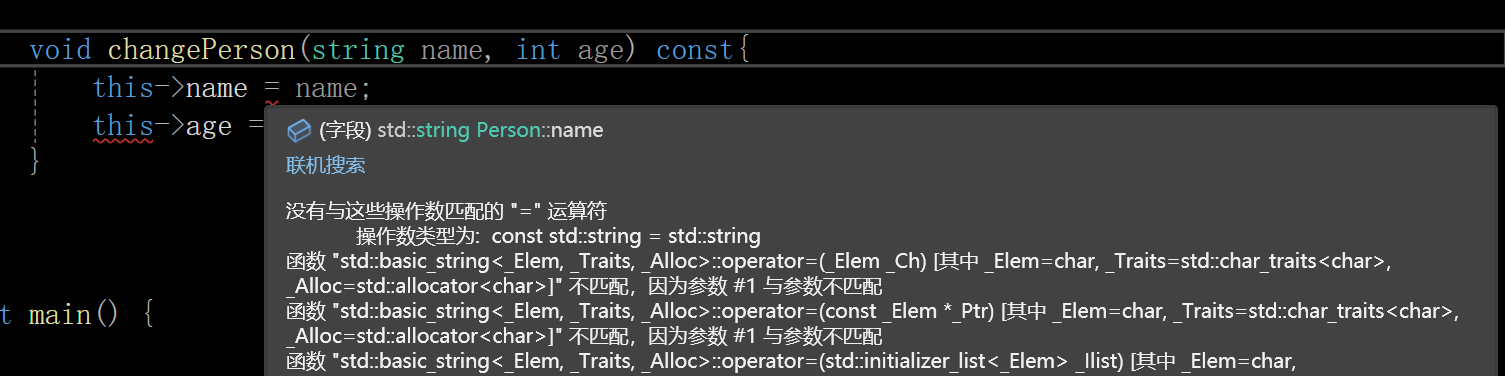
常对象
- 创建对象的时候使用const修饰对象
- 能读取仍受访问权限限制;const 对象不能修改普通成员,mutable 成员有例外。
- 常对象,只能调用常函数,不能调用普通函数
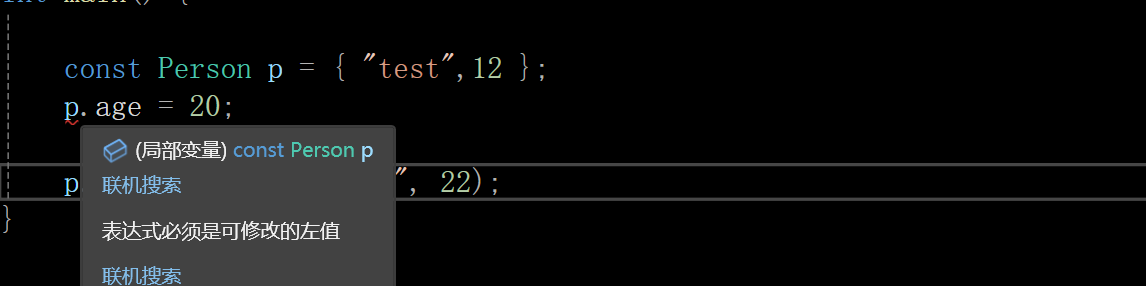
发现无法进行赋值,但是可以读取里面的值,而且能够调用常函数
mutable
修饰属性,表示可变
- 被修饰的属性可以在常函数中修改,也可在常对象里面修改
#include <string>using namespace std;
class Person {public:  string name;  mutable int age;  Person() :name(""), age(0) {};  Person(string name, int age) :name(name), age(age) {};
  void changePerson(string name, int age) const{    this->age = age;  }};

int main() {
  const Person p = { "test",12 };  // p.age = 20;  p.age = 20;  p.changePerson("test2", 22);}
友元
友元是什么?
类的主要特点是可以隐藏自己内部的数据,外界无法访问,有的时候需要在外部访问类的私有成员,需要友元函数,也就是特权函数
全局函数做友元
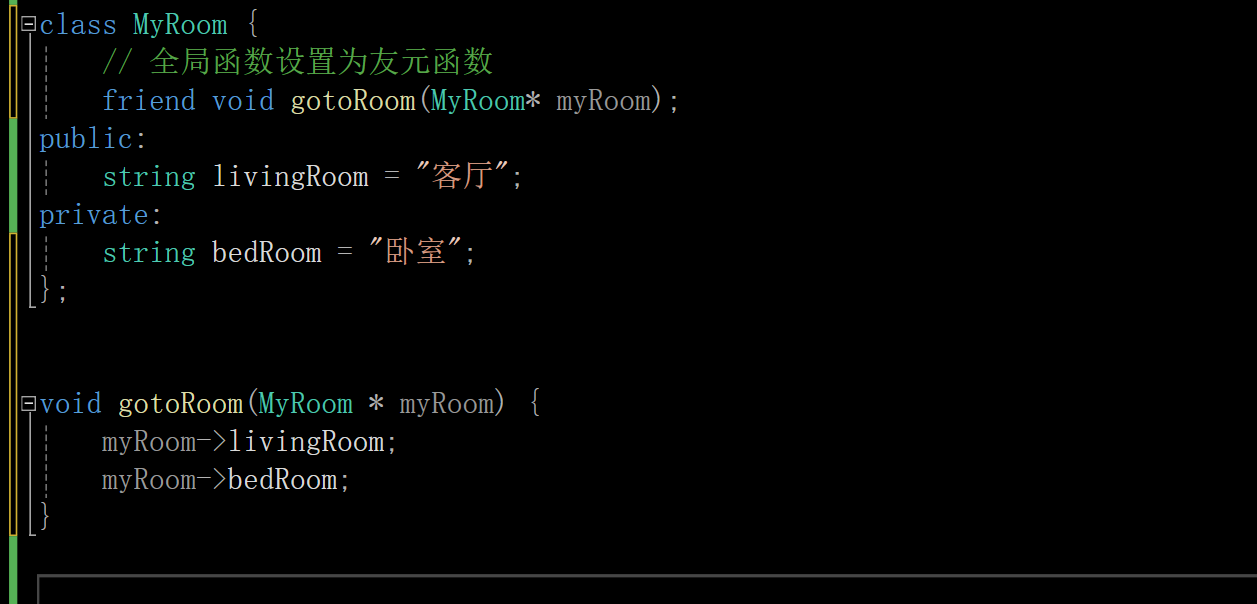
定义一个房子,有一个私有属性和公有属性
class MyRoom {public: string livingRoom = "客厅";private: string bedRoom = "卧室";};使用函数来访问这个私有属性,很显然是无法访问的,
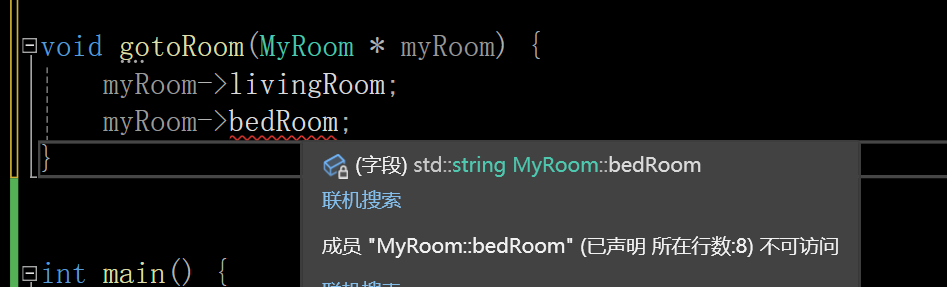
我们可以将当前函数设置为友元函数,然后可以正常访问
成员函数做友元
实现较为复杂。
#include <string>
#include<iostream>using namespace std;
// 1.必须要先声明class MyRoom;
// 2.必须要在MyRoom上面class GoodFriend {public:  MyRoom* myRoom;
  //3. 不能在此处实现  void visit();};

class MyRoom {  // 4.成员函数做友元  friend void GoodFriend::visit();public:  string livingRoom = "客厅";private:  string bedRoom = "卧室";};
//5.实现成员函数void GoodFriend::visit() {  cout << myRoom->bedRoom << endl;  cout << myRoom->livingRoom << endl;}
int main() {  GoodFriend gd;  MyRoom mm ;  gd.myRoom = &mm;  gd.visit();}
类做友元
类里面的所有成员函数都能访问私有属性
class Room {  friend class Friend;public:  string liveingRoom = "客厅";private:  string bedRoom = "卧室";};
class Friend {  Room* room;  void visit() {    room->liveingRoom;    room->bedRoom;  }};
重载运算符
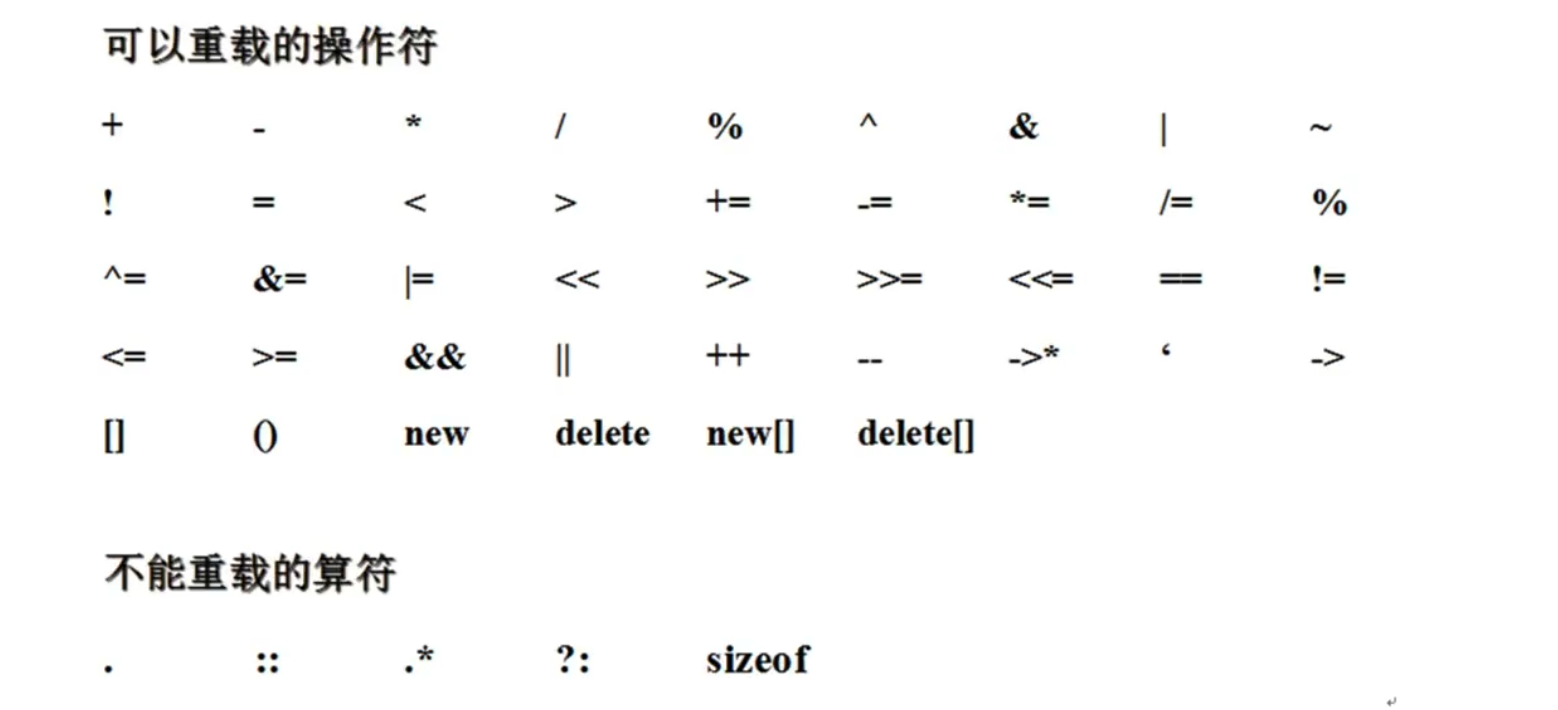
对已有的运算符进行重新定义,适应不同的数据结构
可重载运算符
+运算重载
必须要使用operator+对应的重载运算符号
#include <iostream>using namespace std;
class Point {public:  int x;  int y;
  Point() :x(0), y(0) {};  Point(int x, int y) : x(x), y(y) {};
};

Point operator+(Point p1,Point p2) {  return Point(p1.x + p2.x, p1.y + p2.y);}
int main() {  Point p1 = { 1,2 };  Point p2 = { 2,2 };
  Point p3 = p1 + p2;
  cout << "x=" << p3.x << " y=" << p3.y << endl;}
但是以上方式比较耗费空间,因为每次都是值复制,所有我们可以使用引用
Point operator+(const Point& p1,const Point& p2) { return Point(p1.x + p2.x, p1.y + p2.y);}可以在类里面定义,但是只能有一个函数
class Point {public:  int x;  int y;
  Point() :x(0), y(0) {};  Point(int x, int y) : x(x), y(y) {};
  // 里面只能有一个参数  Point operator+(const Point& p1) {    return { this->x - p1.x,this->y - p1.y };  }
};
++运算重载
先运算,在取值
Point operator++( Point& p) { p.x++; p.y++; return p;}先取值,后运算
Point operator++(Point& p,int) { Point point = p; p.x++; p.y++; return point;}—运算重载
类里面
先运算后取值
Point operator--() { x--; y--; return *this; }先取值后运算
Point operator--(int) { Point temp = *this; x--; y--; return temp; }<<重载运算符
以下是预期编译失败的反例:类型还没有提供此处使用的运算符。不要把这段当作可直接运行的实现。
#include <string>
#include<iostream>using namespace std;
class Person {private:  string name;  int age;  string gender;  int score;public:  Person() :name(""), age(0), gender(""), score(0) {};  Person(string name, int age, string gender, int score) :name(name), age(age), gender(""), score(score) {};};

int main() {  Person person = { "test",1,"1",100 };  cout << person << endl;}
但是以上写法肯定是不行的
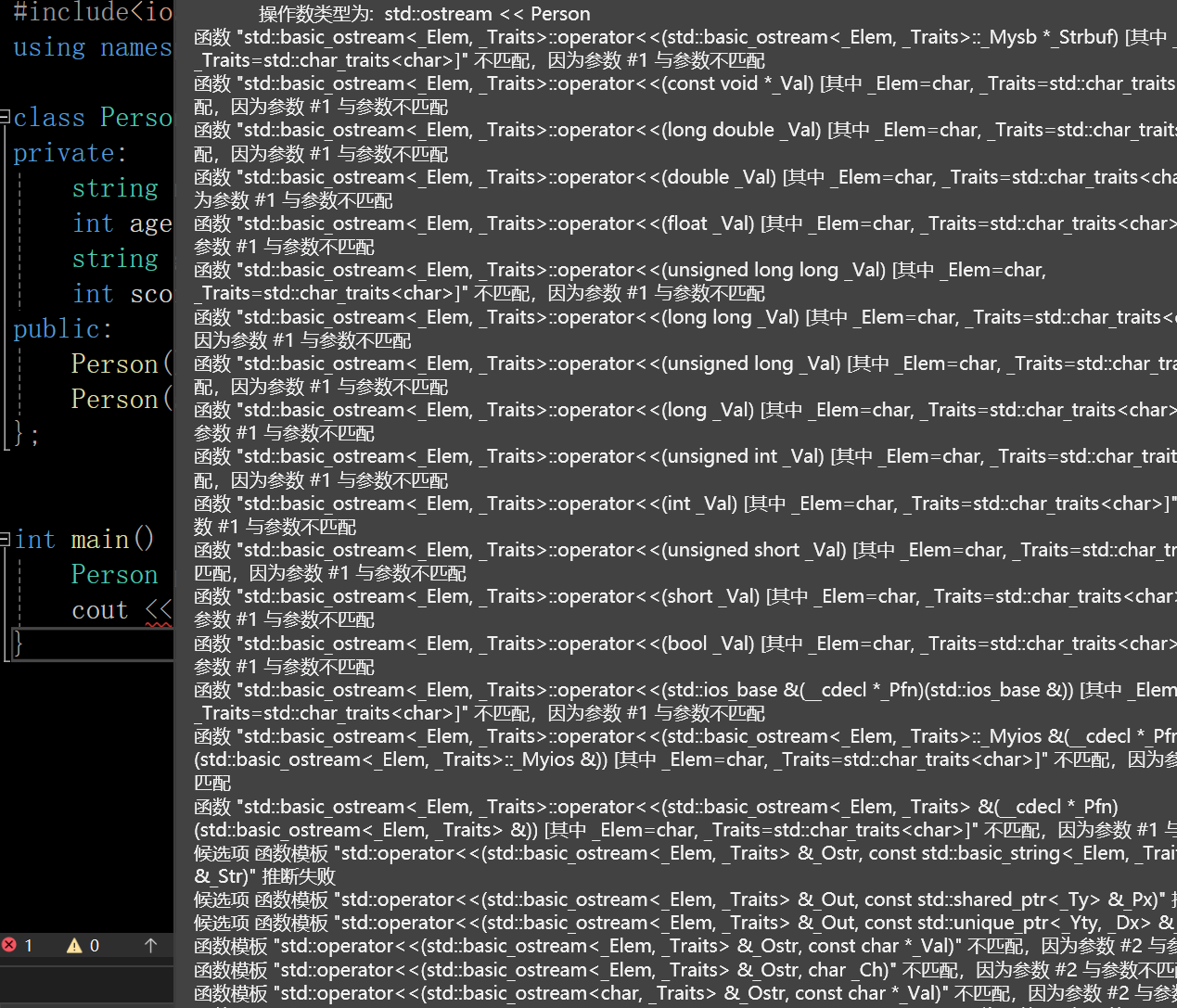
所以我们需要重载流式运算符
#include <string>
#include<iostream>using namespace std;
class Person {  // 友元  friend ostream& operator<<(ostream& os, const Person& p);private:  string name;  int age;  string gender;  int score;public:  Person() :name(""), age(0), gender(""), score(0) {};  Person(string name, int age, string gender, int score) :name(name), age(age), gender(""), score(score) {};};
// 重载运算符<<ostream& operator<<(ostream& os,const Person& p) {  os << "name=" << p.name << "age=" << p.age << "gender=" << p.gender << "score=" << p.score << endl;  return os;}
int main() {  Person person = { "test",1,"1",100 };  cout << person << endl;}
<<重载需要使用ostream
==运算符
#include <string>
#include<iostream>using namespace std;
class Person {  friend ostream& operator<<(ostream& os, const Person& p);private:  string name;  int age;  string sex;  int* score;public:  Person() :name(""), age(0), sex(""), score(nullptr) {};  Person(string name, int age, string sex, int* score) :name(name), age(age), sex(sex), score(score) {};
  Person(const Person& person) {    this->name = person.name;    this->age = person.age;    this->score = new int(*person.score);    this->sex = person.sex;  }

  // 重载运算符=  Person& operator=(const Person& person) {    name = person.name;    age = person.age;    sex = person.sex;    score = new int(*person.score);
    return *this;  }
  ~Person() {    if (score != nullptr) {      delete score;      score = nullptr;    }  }
};

ostream& operator<<(ostream& os, const Person& p) {  os << "name=" << p.name << "age=" << p.age << "sex=" << p.sex << "score=" << *p.score << endl;  return os;}
int main() {  Person p1 = { "test",10,"1",new int(10)};  cout << p1 << endl;
  // 此时p2并没有完成空间的开辟,实例化,只是进行了拷贝构造函数  Person p2 = p1;  // p2此时已经完成了空间开辟,赋值运算符  p2 = p1;  cout << p2 << endl;}
封装
面向对象三大特征,封装,继承,多态
- 将具体属性封装实现,把对象成员变量的访问进行私有化,只能在类里面访问,但是可以通过公共方法间接调用
- 提高了代码的安全性,复用性,可读性
#include <string>
#include<iostream>using namespace std;
class Person {private:  string name;  int age;
public:  // 封装set,get属性  void setAge(const int& age) {    if (age > 140 || age < 0) {      cout << "年龄不合法" << endl;      return;    }    this->age = age;  }
  int getAge() {    return this->age;  }
  void setName(const string& name) {    this->name = name;  }
  string getName() {    return this->name;  }
  // 构造函数  Person() :name(""), age(0) {};  Person(string name, int age) :name(name), age(age) {};  // 拷贝函数  Person(const Person& p) {    age = p.age;    name = p.name;  }};
int main() {  Person p;    // 属性赋值  p.setAge(1000);  p.setName("张三");  cout << p.getAge() << endl;  cout << p.getName() << endl;}
继承
继承的使用
通过子类 :[继承方式]父类
- 所有的成员都可以继承给子类,私有的成员无法继承
- 子类可以访问从父类继承到的成员
- 一个类继承了其他类之后,也可以被其他类继承
- 简化代码、提高代码的复用性。
#include <string>
#include<iostream>using namespace std;
class Animal {private:  int age;
public:  string name;
  void walk() {    cout << this->name << "走路" << endl;  }};
// 子类类名:[继承方式]父类类名class Dog :public Animal {
};
int main() {  Dog dog;  dog.walk();}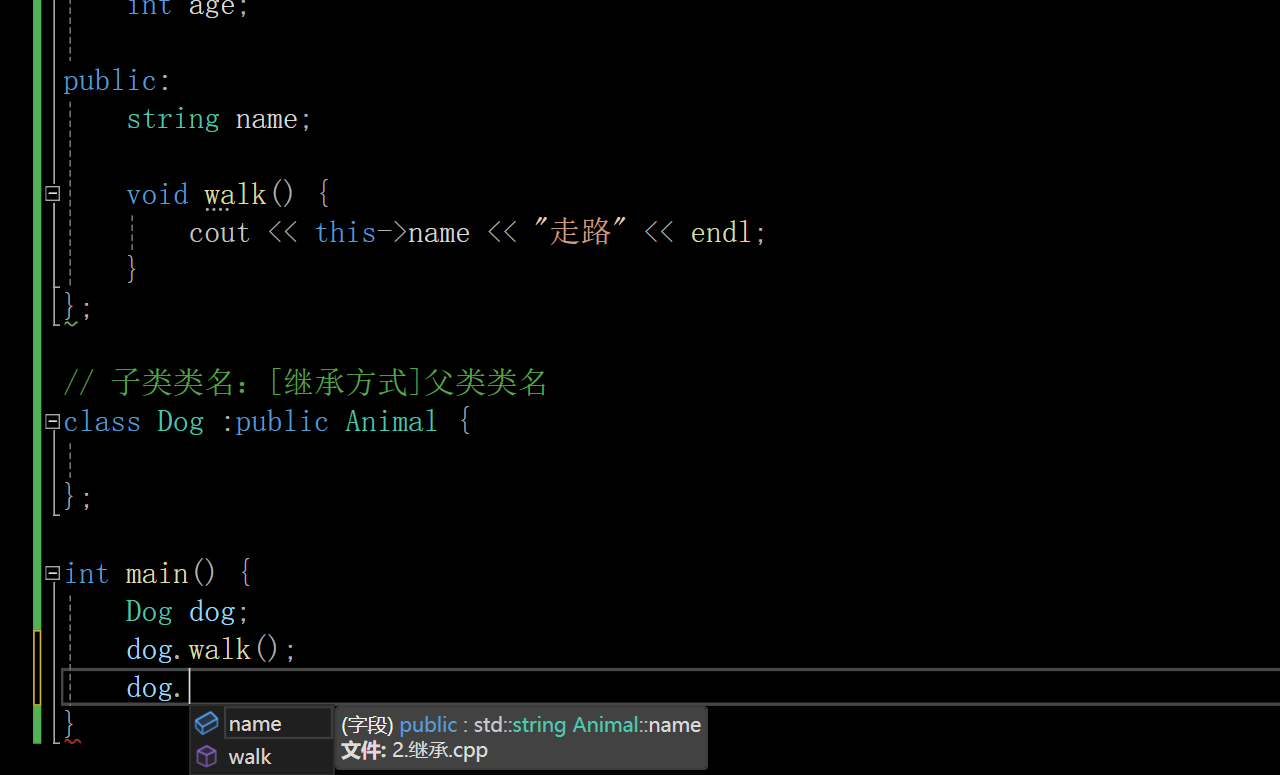
继承的特点
- 父类中的所有非静态成员,都可以继承给子类(除了构造函数,析构函数)
- 一个类可以被多个类继承
- 一个类可以有多个父类(多继承)
- 一个类在继承了一个类后,其他类也能继承这个类
- 私有的属性子类里面也有,但是子类由于权限的问题,无法访问
继承的权限
- public:所有的类都能访问
- protected: 继承的子类和当前类能访问
- private:只能在当前类访问
类的三种继承方式
- 公共继承:继承父类属性(函数),保留原有的访问权限
- 保护继承:继承父类属性(函数),超过proteced权限部分,降为protected权限
- 私有继承:继承父类属性(函数),将访问权限都设置为private权限
C++默认采用的私有继承
子类构造函数和析构函数
- 当子类被创建的时候,会调用父类的构造函数,来初始化父类继承的部分。默认调用的是父类的无参构造
- 父类里面没有无参构造,子类里面也不能使用无参构造
- 解决方式
-
- 父类添加无参构造,修改访问权限
- 直接显示调用父类有参构造函数
-
- 解决方式
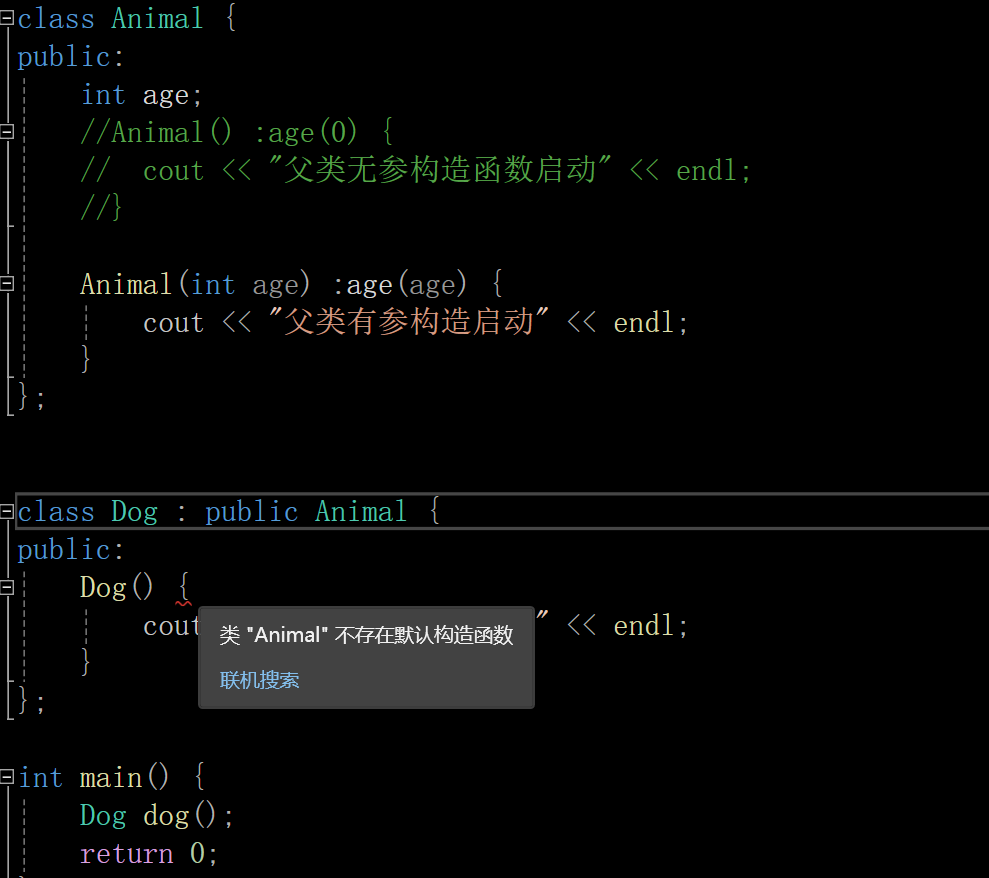
有参调用父类构造函数
class Dog : public Animal {public:  Dog() :Animal(10){    cout << "子类构造函数启动" << endl;  }
};
析构函数
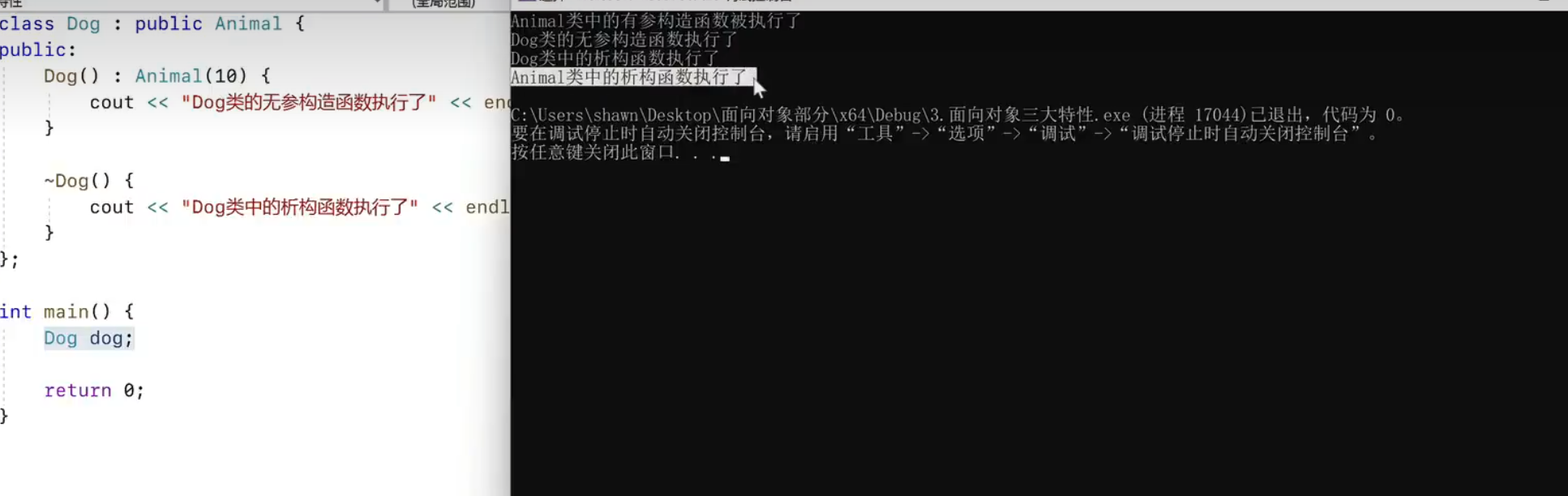
子类销毁的时候会先调用自己的析构函数,然后再调用父类的析构函数
父类和子类出现同名成员
子类会将父类继承到的成员隐藏,子类对象直接访问,访问的是子类里面的成员。
但是如果想要调用父类里面的成员,需要通过子类.父类:成员(dog.Animal::showAge())访问
多继承
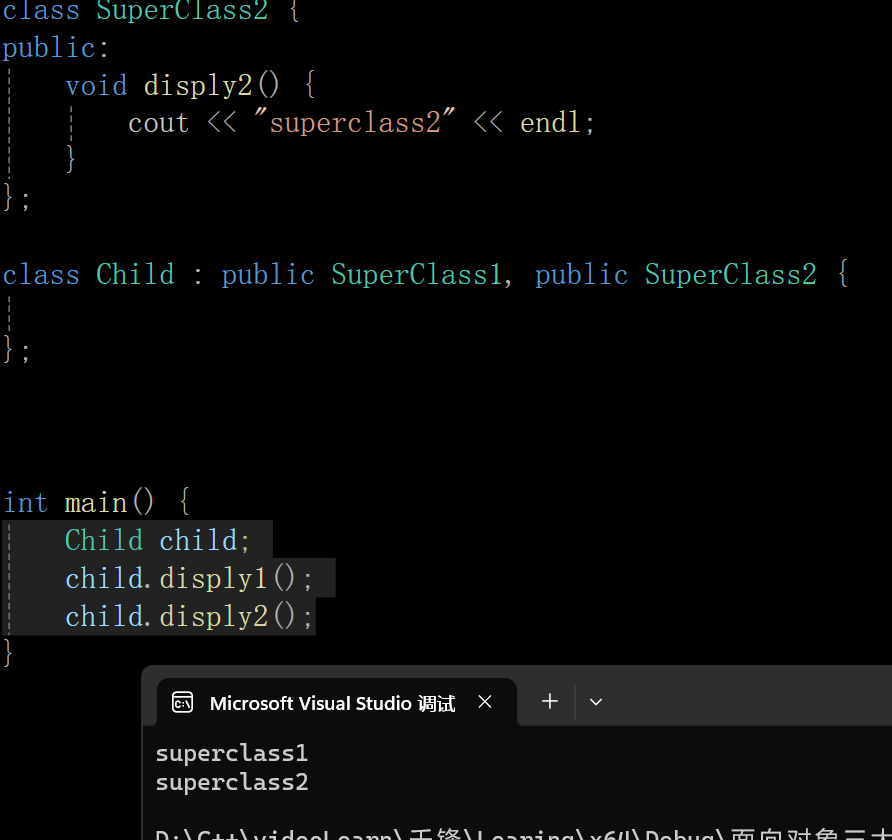
使用方式,和单继承一样,但是需要在后面使用,隔开,并且需要使用对应的访问权限标识,否则后面的父类都是私有的
class SuperClass1 {public:  void disply1() {    cout << "superclass1" << endl;  }};
class SuperClass2 {public:  void disply2() {    cout << "superclass2" << endl;  }};
class Child : public SuperClass1, public SuperClass2 {
};
可能会带来二义性问题
如果多个父类中存在多个相同名字的成员后,子类无法分辨究竟是调用的哪一个,必须要使用显示指明父类
child.SuperClass1::display()child.SuperClass2::display()菱形继承
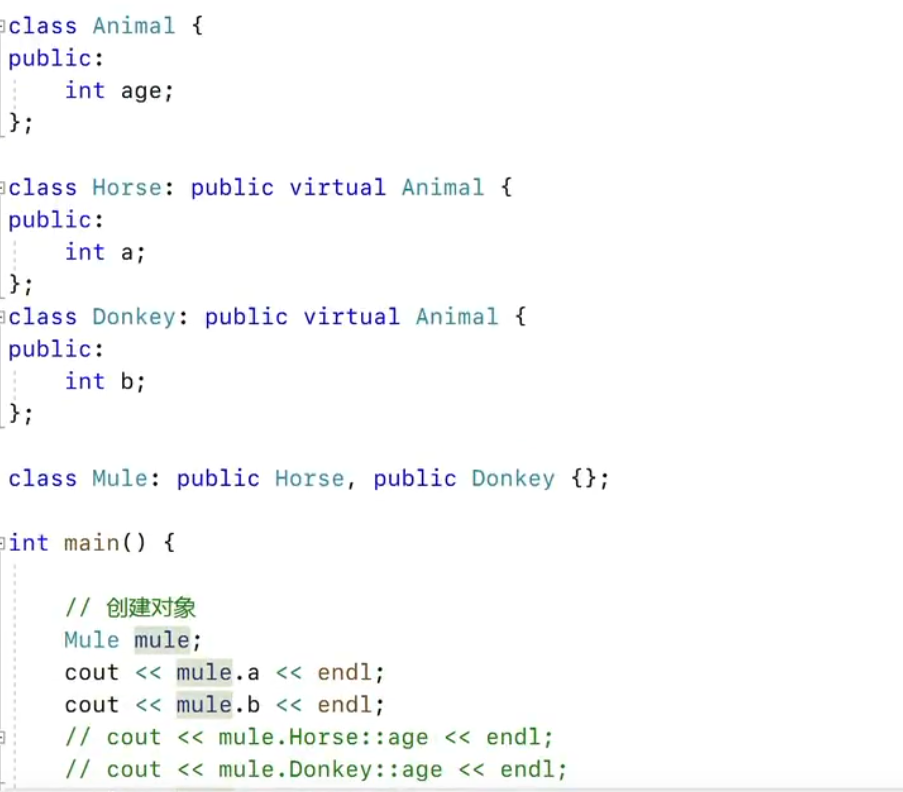
两个派生类继承到相同的父类,但是他们有相同的子类。
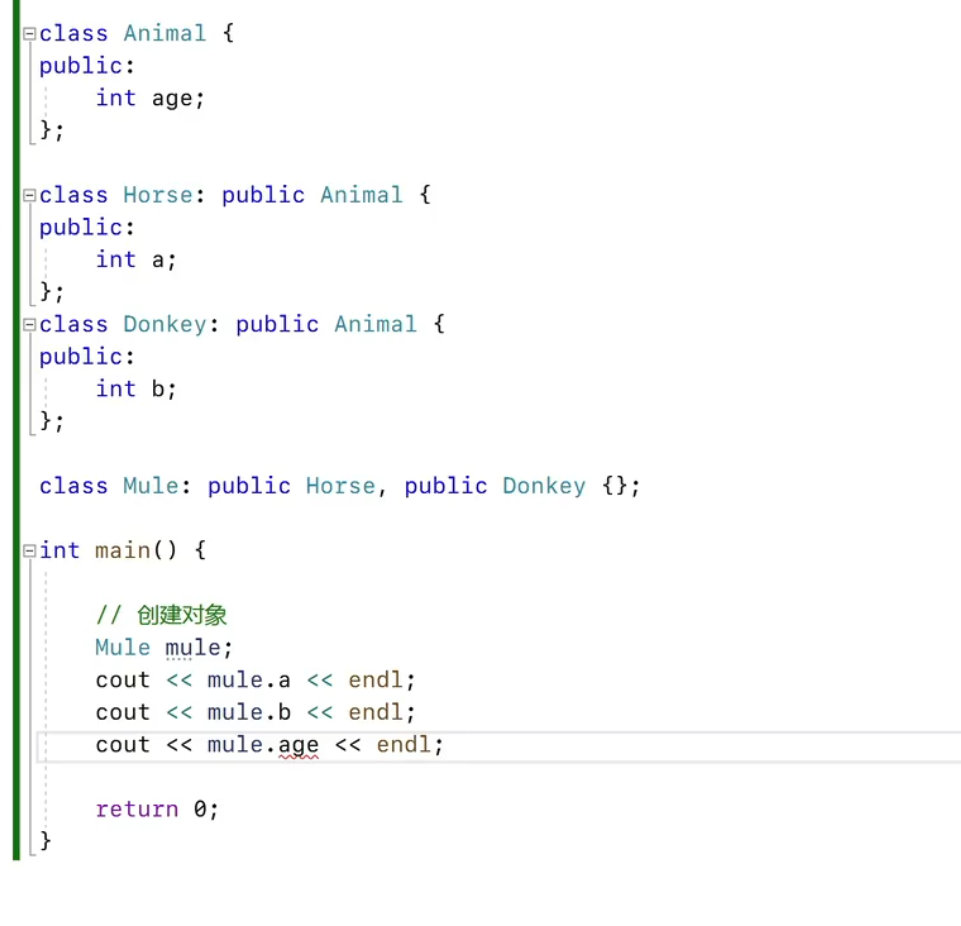
存在的问题是二义性,
- 我们可以要使用显示调用
- 虚继承(virtual):为了解决菱形继承的时候命名问题,让派生类中只保留一个相同的间接父类中的成员
多态
一个类的引用指向另一个类的对象,从而产生多种形态,当两者存在直接或间接的继承关系时候,父类引用子类的对象。
编译时多态(静态多态):运算重载,函数重载,函数地址是早绑定(在编译阶段就可以确定函数的调用地址)
运行时多态(动态多态):派生类和虚函数,函数地址是晚绑定,函数的调用地址不能在编译期间确定
对象转型
多态的前提:
-
父类的引用指向子类的对象,父类的指针指向子类的对象
-
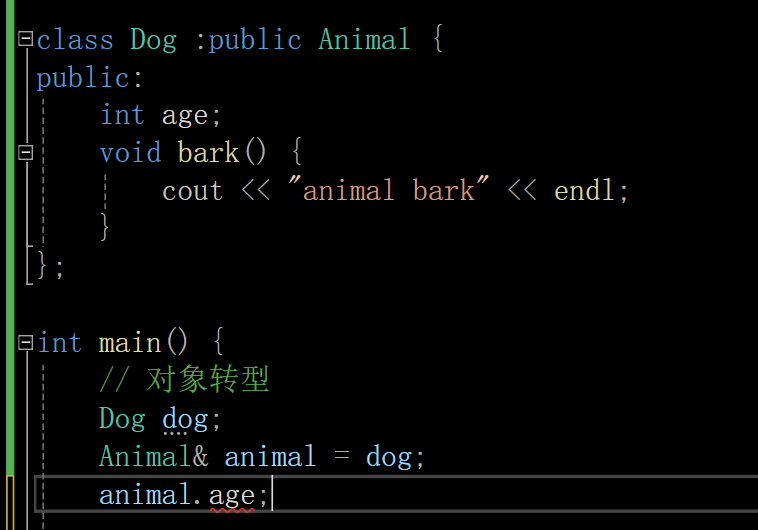
对象转换为父类的引用/指针,只能访问父类中存在的成员无法访问子类里面定义的成员
#include<iostream>using namespace std;
class Animal {public:  void bark() {    cout << "animal bark" << endl;  }};

class Dog :public Animal {
};
int main() {  // 对象转型    // 方式1  Dog dog;  Animal& animal = dog;
    // 方式2  // 在堆上创建,父类的指针指向子类  Dog* dog1 = new Dog();  Animal* animalPointer = dog1;    animalPointer->bark();    delete dog1;
}
很显然父类无法调用子类里面的成员
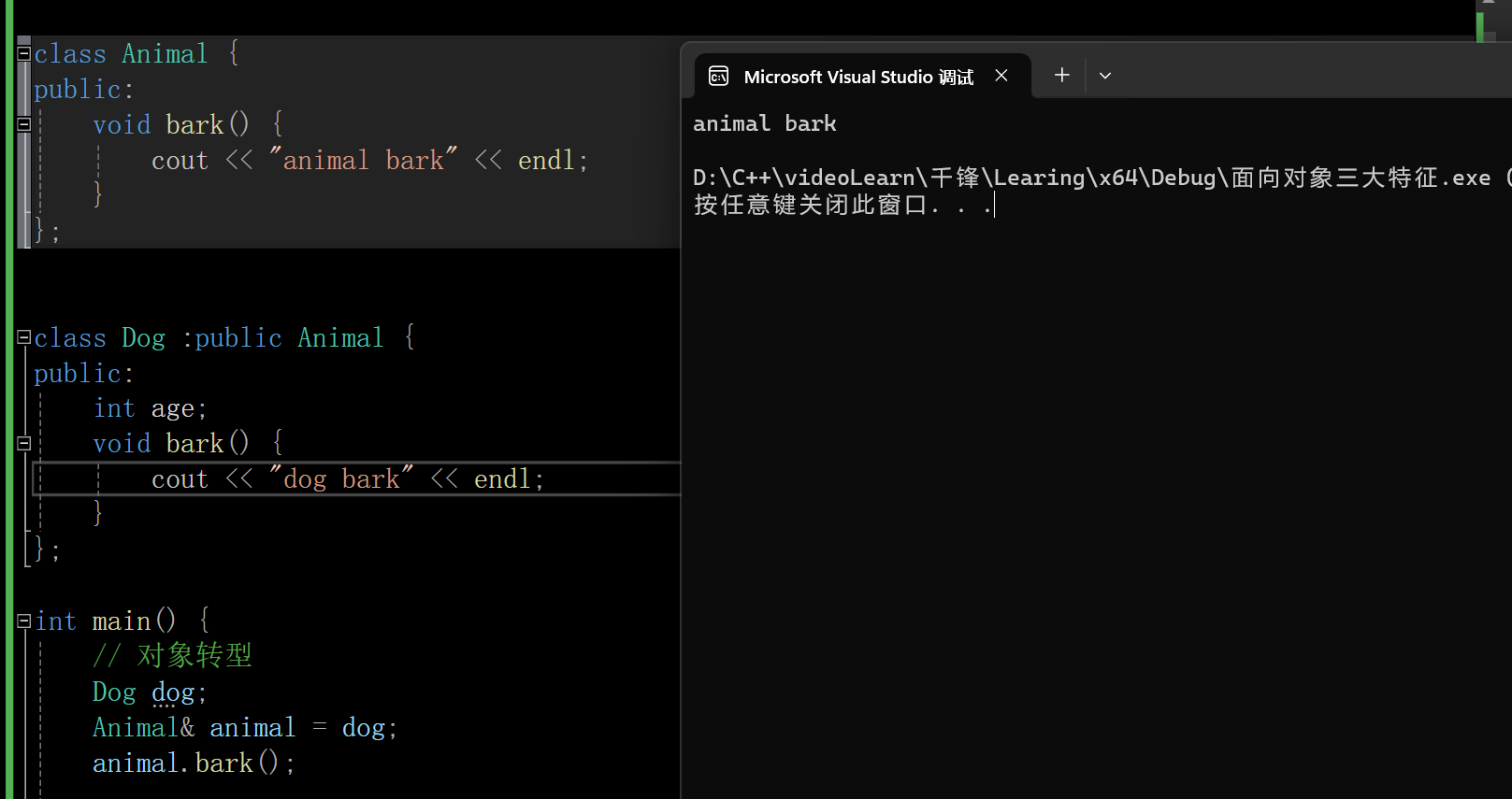
除此之外,如果父类函数和子类函数一样,那么多态对象转型的时候,依然是调用的父类函数
虚函数
当绑定在程序运行之前,称为早绑定
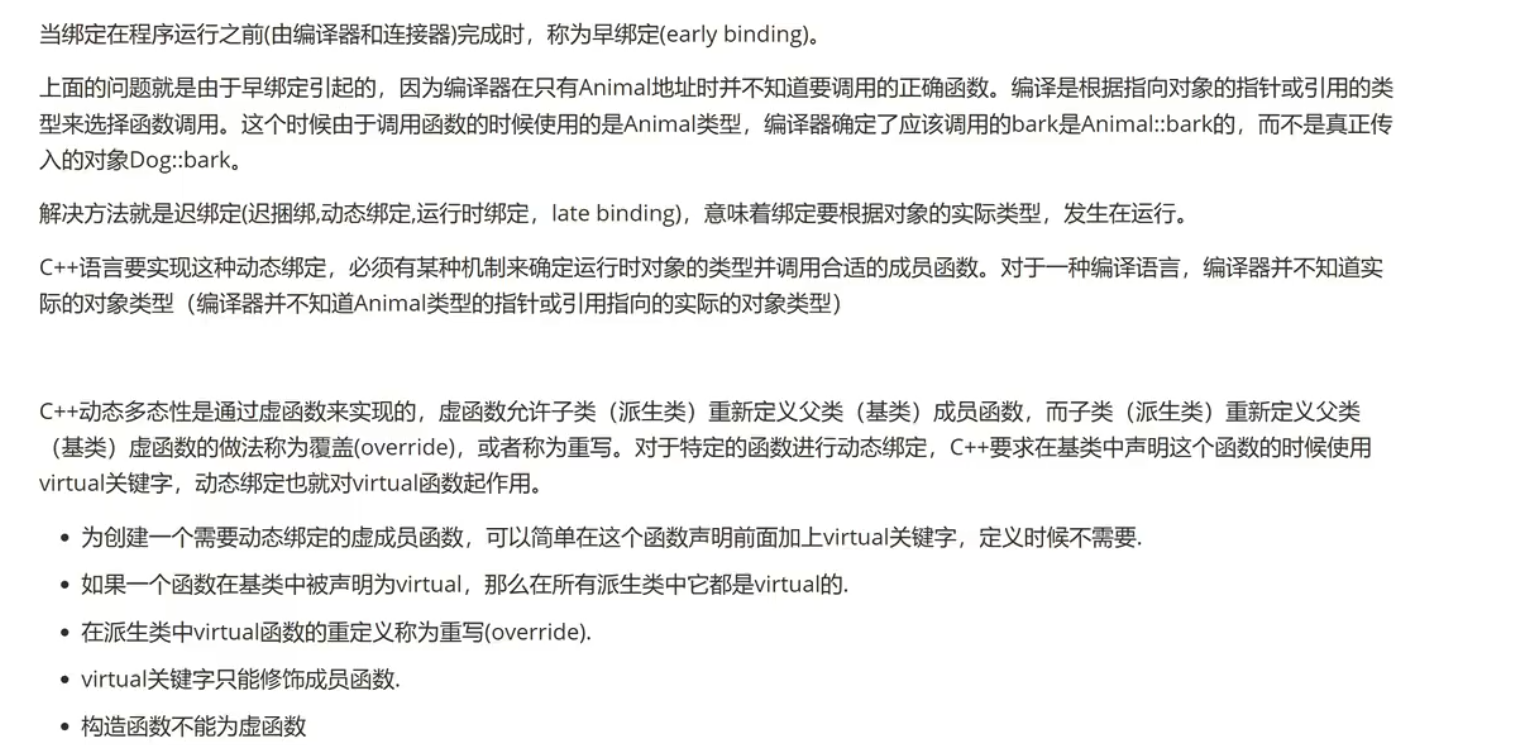
class Animal {public:  // 虚函数,延迟绑定  virtual void bark() {    cout << "animal bark" << endl;  }};

class Dog :public Animal {public:  int age;  Dog() :age(0) {};
  // 虚函数的重写  void bark() override {    cout << "dog bark" << endl;  }};
多态案例
#include <string>
#include<iostream>using namespace std;
class SF {public:  void sendPackage() {    cout << "SF发送" << endl;  }};

class EMS {public:  void sendPackage() {    cout << "EMS发送" << endl;  }};

class JD {public:  void sendPackage() {    cout << "JD发送" << endl;  }};// 违背了程序设计的原则:开闭原则// 有新功能来的时候只需要拓展模块实现,不能修改已有的代码void send(string name) {  if (name == "SF") {    SF().sendPackage();  }  else if (name == "EMS") {    EMS().sendPackage();  }  else {    JD().sendPackage();  }}int main() {  send("SF");
  return 0;}
修改,使用多态
#include <string>
#include<iostream>using namespace std;
// 父类class ExpressCompany {public:  virtual void sendPackage() {};};
class SF :public ExpressCompany{public:  void sendPackage() override {    cout << "SF发送" << endl;  }};

class EMS :public ExpressCompany{public:  void sendPackage() override {    cout << "EMS发送" << endl;  }};

class JD :public ExpressCompany{public:  void sendPackage() override {    cout << "JD发送" << endl;  }};#if 0void send(string name) {  if (name == "SF") {    SF().sendPackage();  }  else if (name == "EMS") {    EMS().sendPackage();  }  else {    JD().sendPackage();  }}#elsevoid send(ExpressCompany& ex) {  ex.sendPackage();}
#endif

int main() {  EMS ems;  JD jd;  send(ems);  send(jd);  return 0;}
纯虚函数与抽象类
希望基类只作为其派生类的一个接口
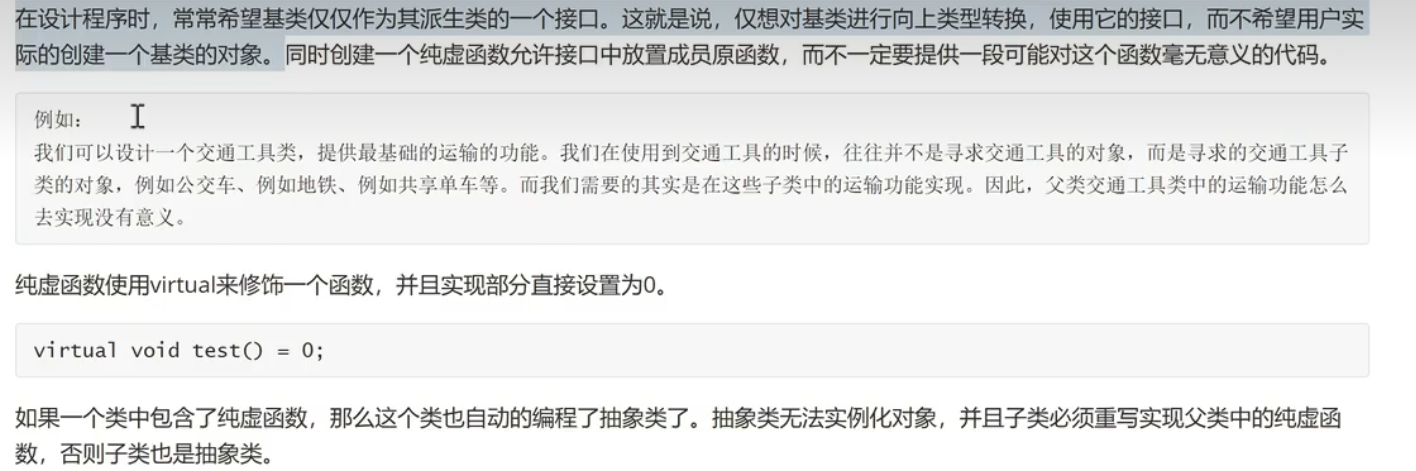
#include<iostream>using namespace std;
// 纯虚函数:一个虚函数的实现部分设置为了0,那么这样的话就是纯虚函数,纯虚函数只有声明,没有实现// 抽象类:一个类里面包含了纯虚函数,这个类就是抽象类,抽象类不能创建对象class TrafficTools {public:  // 纯虚函数  virtual void transport() = 0;};
// 继承抽象类,必须要重写父类里面的纯虚函数,否则这个类也是抽象类,无法创建对象class Bus :public TrafficTools {public:  void transport() override {    cout << "bus" << endl;  }};
class Bike :public TrafficTools {public:  void transport() override {    cout << "bike" << endl;  }};

int main() {  Bus bus;  bus.transport();
  Bike bike;  bike.transport();  return 0;}
纯虚函数和多继承

#include<iostream>using namespace std;

class Cooker {public:  virtual void buyFood() = 0;  virtual void cook() = 0;  virtual void eat() = 0;};

class Maid {public:  virtual void cook() = 0;  virtual void wash() = 0;  virtual void clean() = 0;};
class Person : public Cooker, public Maid {public:  void buyFood() override {    cout << "buyfood" << endl;  }
  void wash() override {    cout << "wash" << endl;  }
  void cook() override {    cout << "cook" << endl;  }
  void clean() override {    cout << "clean" << endl;  }
  void eat() override {    cout << "eat" << endl;  }};int main() {  Person p;  p.buyFood();  p.clean();
  return 0;}
多态案例

#include<iostream>using namespace std;
//空运抽象类class AirTransport {public:  // 空运  virtual void sendAirTransport() = 0;
};
class LandTransportation {public:  // 陆运  virtual void sendLandTransportation() = 0;};
// 顺丰有陆运和空运class SF: public AirTransport, public LandTransportation {public:  void sendAirTransport() override {    cout << "顺丰空运" << endl;  }  void sendLandTransportation() override {    cout << "顺丰陆运" << endl;  }
};
// EMS只有空运class EMS : public AirTransport {public:  void sendAirTransport() override {    cout << "EMS空运" << endl;  }};
// 圆通只有陆运class YT : public LandTransportation {public:  void sendLandTransportation() override {    cout << "圆通陆运" << endl;  }};

void sendAir(AirTransport& air) {  air.sendAirTransport();}
void sendLand(LandTransportation& land) {  land.sendLandTransportation();}
int main() {  SF sf;  EMS ems;  YT yt;  sendAir(sf);  sendAir(ems);  sendLand(yt);  sendLand(sf);}
虚析构函数
析构函数是对象生命周期的终点,在对象被销毁前调用,一般是对资源进行释放。
但是在多态中,如果我们使用父类的引用来销毁空间的话,可能出现子类中引用的堆空间无法销毁的情况,造成内存泄露,解决方案就是给父类添加虚析构函数。
#include<iostream>using namespace std;
class Animal {public:  ~Animal(){    cout << "父类的析构函数执行了" << endl;  }};
class Person :public Animal{public:  int* n;  Person() {    n = new int(10);  };  ~Person(void) {    cout << "子类析构函数执行" << endl;    if (n != nullptr) {      delete n;      n = nullptr;    }  }};
int main() {  Animal* ani = new Person();  delete ani;}
可以看见,没有执行子类的析构函数。
只需要我们使用析构函数改成虚析构函数,子类重写
#include<iostream>using namespace std;
class Animal {public:  virtual ~Animal(){    cout << "父类的析构函数执行了" << endl;  }};
class Person :public Animal{public:  int* n;  Person() {    n = new int(10);  };  ~Person() override{    cout << "子类析构函数执行" << endl;    if (n != nullptr) {      delete n;      n = nullptr;    }  }};
int main() {  Animal* ani = new Person();  delete ani;  // 如果没有虚析构函数的话,这里通过ani来销毁空间,销毁开辟出来的堆上面的Person对象空间  // 但是由于没有执行子类中的析构函数,导致子类成员n所对应的堆没有被释放,导致内存泄露  return 0;}
结构体
struct
- 定义属性
- 定义构造函数
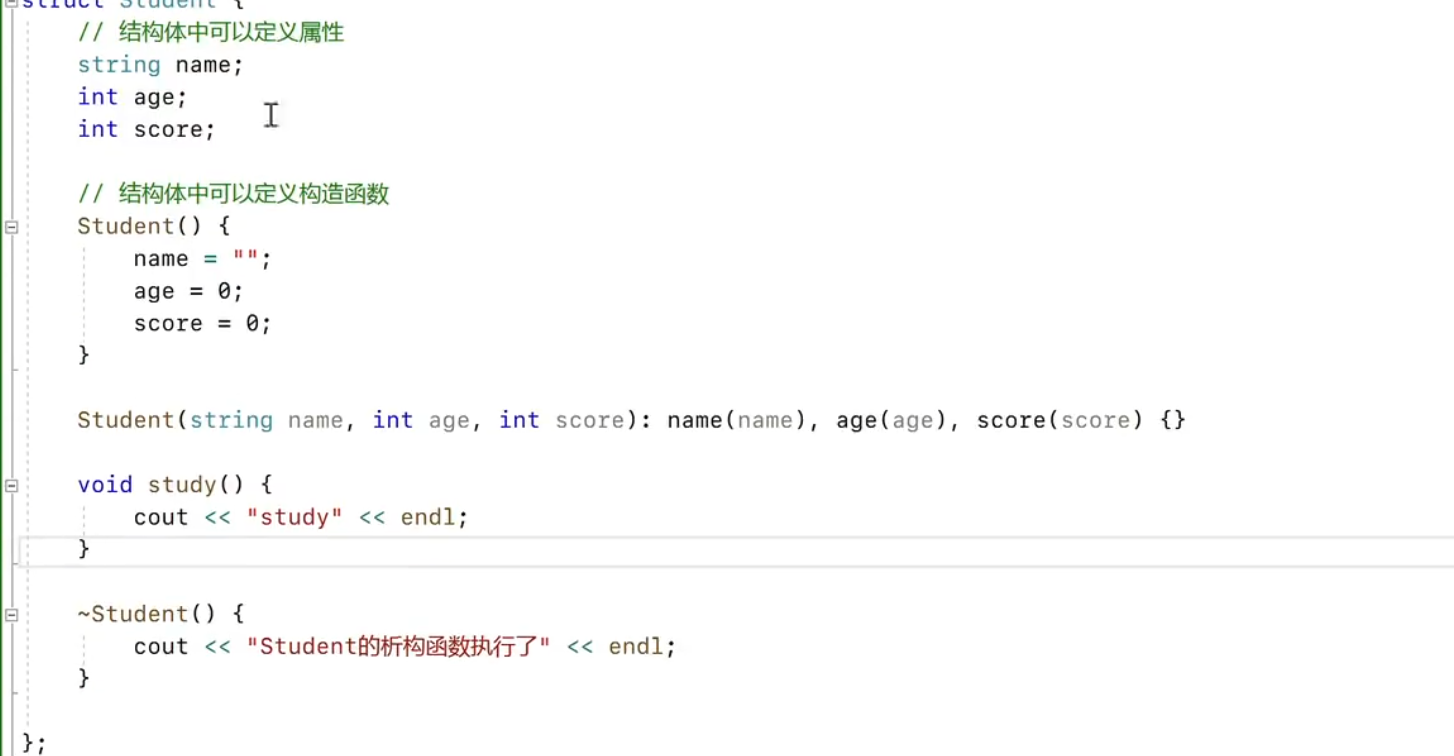
和类基本上一样
#include <string>
#include<iostream>using namespace std;
struct Student {  string name;  int age;  Student() {    name = "";    age = 0;  }
  Student(string name, int age) :name(name), age(age) {};
  void study() {    cout << "开始学习" << endl;  }  ~Student() {    cout << "析构函数执行了" << endl;  }};
int main() {  // 创建结构体   struct Student student;   struct Student xiaohei = { "eee",12 };   struct Student xiaohong = Student("小红", 22);   struct Student* xiaobai = new Student();   struct Student* xiaogui = new Student("xiaogui", 22);   xiaohei.study();}
成员默认的访问权限不同的
类的默认成员类型是private类型。结构体默认是public
模板
模板的介绍
建立通用的函数,函数类型和形参类型不具体指定,用虚拟的类型来代表

函数模板的定义
template<typename T,typename M>void add(T n1, M n2) { cout << n1 + n2 << endl;}template<typename T>void mySwap(T& n1, T& n2) { T temp = n1; n1 = n2; n2 = temp;}函数模板的使用
  // 显示调用  add<int, double>(10, 22);  add<double, int>(22, 10);  add<int>(20,10); // 自动推导
  // 根据实参进行类型的自动推导  add(10, 22);  add('0', '2');
  // 但是需要注意 推导类型的时候,需要注意一致性  int x = 10;  int y = 20;  mySwap(x, y);
可以指定默认的类型
template<typename T = int,typename M = int>void add(T n1, M n2) { cout << n1 + n2 << endl;}返回值使用虚拟类型
模板参数是待推导或指定的类型,不是虚函数类型。返回类型可显式指定,也可使用适用的 auto 返回类型推导。
template<typename R,typename T1,typename T2>R calculate(T1 x, T2 y) { return (R)(x + y);} cout<<calculate<int>(10, 20)<<endl;普通类型和虚拟类型
#include<iostream>using namespace std;
// 虚拟函数template<typename T>int add(T n1, T n2) {  cout << "虚拟函数执行了" << endl;  return n1 + n2;}
// 普通函数执行了int add(int n1, int n2) {  cout << "普通函数执行了" << endl;  return n1 + n2;}

int main() {  int x = 0;  char ch = 'a';  add(0, ch);

  // 普通函数  int a = 1;  int b = 2;  add(a, b);}
我们可以看到执行的是普通函数,因为普通函数有类型转换,模板函数无法判断类型
- 普通函数有类型转换
- 如果调用的时候,实参可以匹配普通函数,又可以匹配函数模板,有限调用普通函数
函数模板局限性
如果使用的是类的话,会出现问题
以下是预期编译失败的反例:类型还没有提供此处使用的运算符。不要把这段当作可直接运行的实现。
#include <string>
#include<iostream>using namespace std;

class Person {public:  string name;  int age;  int score;  Person() :name(""), age(0), score(88) {};  Person(string name, int age, int score) :name(name), age(age), score(score) {};
};

template<typename T>int compare(T& t1, T& t2) {  if (t1 > t2) {    return 1;  }  else if (t1 < t2) {    return -1;  }  else {    return 0;  }}

int main() {  Person p1;  Person p2;  compare(p1, p2);}
以上代码看不出来什么问题,但是执行后会报错

两种方式
- 重载运算符
// 重载运算符bool operator> (const Person& p1, const Person& p2) {  return p1.age > p2.age;}
bool operator< (const Person& p1, const Person& p2) { return p1.age < p2.age;}- 函数模板重载
需要使用<>来标明特定的类别
template<>int compare<Person>( Person& p1, Person& p2) { if (p1.age > p2.age) { return -1; } else if (p1.age < p2.age) { return 1; } else { return 0; }}函数模板的案例
定义一个函数模板,将数组中的元素拼接成字符串返回。
使用sstream类库作为输出
#include <string>
#include<iostream>#include<sstream>using namespace std;

template<typename T>string toString(T * array,int len) {  if (len == 0 || array == nullptr) {    return "[]";  }
  ostringstream oss;  oss << "[";  for (int i = 0; i < len-1; i++) {    oss << array[i] << ",";  }
  oss << array[len - 1] << "]";
  return oss.str();}

int main() {  int arr[] = { 1,2,3,4 };  cout<<toString(arr, 4)<<endl;
}
数组排序,函数模板
template<typename T>void mySort(T* array, int len) { for (int i = 0; i < len; i++) { for (int j = 0; j < len - i - 1; j++) { if (array[j] > array[j + 1]) { T temp = array[j]; array[j] = array[j + 1]; array[ j + 1 ] = temp; } } }}类模板
和函数模板类似;C++17 起支持在适用情形下进行类模板实参推导,其他情况仍需显式给出类型。
类模板的定义和使用
#include<iostream>using namespace std;

template<typename T1, typename T2>class NumOperator {private:  T1 num1;  T2 num2;public:  NumOperator() :num1(0), num2(0) {};  NumOperator(T1 num1, T2 num2) :num1(num1), num2(num2) {};
  NumOperator(const NumOperator& numOperator) {    cout << "拷贝构造函数" << endl;    num1 = numOperator.num1;    num2 = numOperator.num2;  }
  ~NumOperator() {    cout << "析构函数" << endl;  }
  void showAdd() {    cout << num1 + num2 << endl;  }
  void showMinus() {    cout << num1 - num2 << endl;  }
};

int main() {  // 必须要声明当前类里面元素的类型  NumOperator<int, int> numoperator = { 10,20 };  numoperator.showAdd();  numoperator.showMinus();}
类模板作为函数的载体
// 普通函数使用类模板必须要明确类型void useCalculator(NumOperator<int, int>& numOperator) {  numOperator.showAdd();}
// 函数模板使用类模板template<typename X,typename Y>void userCalculator2(NumOperator<X, Y>& numoperator) {  numoperator.showAdd();}
类模板的继承
#include <string>
#include<iostream>using namespace std;
template<typename T>class Animal {public:  T arg;};
// 普通类继承class Dog : public Animal<int> {
};

// 模板类继承template<typename E>class Cat : public Animal<E> {
};
int main() {  // 普通类  Dog dog;  dog.arg = 10;
  // 模板类  Cat<string> cat;  cat.arg = "string";}
类模板创建成员变量的时机
类模板成员函数,是在调用函数的时候才会创建,因为编译的时候只知道有这个对象,但是不知道这个对象的具体类型,在调用函数的时候,才会创建这个函数
类模板的函数类外实现
#include<iostream>using namespace std;
template<typename T1,typename T2>class NumberCalculator {private:  T1 n1;  T2 n2;
public:  NumberCalculator();  NumberCalculator(T1 n1, T2 n2);  void add();};

template<typename T1, typename T2>NumberCalculator<T1, T2>::NumberCalculator() {  cout << "类外实现无参构造" << endl;};
template<typename T1, typename T2>NumberCalculator<T1, T2>::NumberCalculator(T1 n1, T2 n2) {  cout << "类外实现有参构造" << endl;  this->n1 = n1;  this->n2 = n2;};
template<typename T1, typename T2>void NumberCalculator<T1, T2>::add() {  cout << this->n1 + this->n2 << endl;
};

int main(){  NumberCalculator<int, int> numcal = { 10,20 };  numcal.add();}
类模板的头文件和原文件分离
虽然引入对应的头文件,但是模板类中的函数是在调用的时候才创建的,因此编译的时候,编译器看不到这些函数,不会管理.cpp里面的对应实现。使用这个函数的时候,发现这个函数已经创建了,但是没有实现,因此报错,相当于头文件里面定义了函数,没有实现。
方式1: 引入.cpp文件,而不是.h头文件
方式2: 类的声明和实现放在同一个文件中,一般定义为 .hpp
类模板的友元函数
第一种方式,类内定义友元
#include<iostream>using namespace std;
template<typename T1,typename T2>class NumCalculator {  // 全局友元函数的类内定义实现  friend void print(const NumCalculator<T1,T2>& cal) {    cout << "n1=" << cal.n1 << " n2=" << cal.n2 << endl;  }private:  T1 n1;  T2 n2;
public:  NumCalculator(T1 n1, T2 n2);};

template<typename T1, typename T2>NumCalculator<T1, T2>::NumCalculator(T1 n1, T2 n2){  this->n1 = n1;  this->n2 = n2;}

int main() {  NumCalculator<int, int> cal = {10,20};  print(cal);}
第二种方式:类外实现
- 友元函数需要使用<>
- 友元函数的实现放在类前面
- 类的声明放在最前面
#include<iostream>using namespace std;
// 提前定义类template<typename T1, typename T2>class NumCalculator;

// 定义在类前面template<typename T1,typename T2>void print(const NumCalculator<T1, T2>& cal) {  cout << "n1=" << cal.n1 << " n2=" << cal.n2 << endl;}


template<typename T1,typename T2>class NumCalculator {
  //friend void print(const NumCalculator<T1, T2>& cal); 无法进行关联  // <>表示一个模板函数  friend void print<>(const NumCalculator<T1, T2>& cal);
private:  T1 n1;  T2 n2;
public:  NumCalculator(T1 n1, T2 n2);};

template<typename T1, typename T2>NumCalculator<T1, T2>::NumCalculator(T1 n1, T2 n2){  this->n1 = n1;  this->n2 = n2;}


int main() {  NumCalculator<int, int> cal = {10,20};  print(cal);}
评论